

原文:In the organizational theorizing that follows, we will not be timid about speculating (Bakan 1975; Moscovici 1972, p. 37; Lave and March 1974, pp. 9-84), striving for interest (Davis 1971), utilizing incongruity as a perspective, anthropomorphizing, reifying, inserting hyperbole, waxing discursive, glossing, improvising, examining alternatives to positivism, reframing, intuiting, and any other tricks that help counteract sluggish imaginations. In the course of directing these various bits and pieces of bias and action at organizations, certain ideas will emerge. The ideas are important, but so is the process by which they were achieved. Our joint interest in the activity of theorizing as well as the product of theorizing, coupled with our belief that the products of theorizing age quickly and have a short half-life (Koestler 1970), should be sufficient to explain why this is a book about organizational theorizing rather than about theory.
参考译文:在接下来的组织化理论建构中,我们将毫不怯懦地进行推测、追求趣味性、将不协调性用作视角、拟人化、物化、插入夸张、铺陈论述、过度简化、即兴发挥、考察实证主义的替代方案、重构框架、直觉洞察,以及任何有助于对抗迟钝想象力的其他技巧。在将这些形形色色的偏见与行动片段指向组织的过程中,某些观念将会浮现。这些观念很重要,但达成它们的过程同样重要。我们对理论建构活动本身以及理论建构产物的共同兴趣,加上我们相信理论产物老化迅速且半衰期很短,足以解释为何本书是关于组织化理论建构而非关于理论的。
💡学习笔记:
这段话是Weick的核心方法论宣言,以近乎叛逆的姿态宣告了一种反传统的理论建构哲学。为“技巧”方法正名:
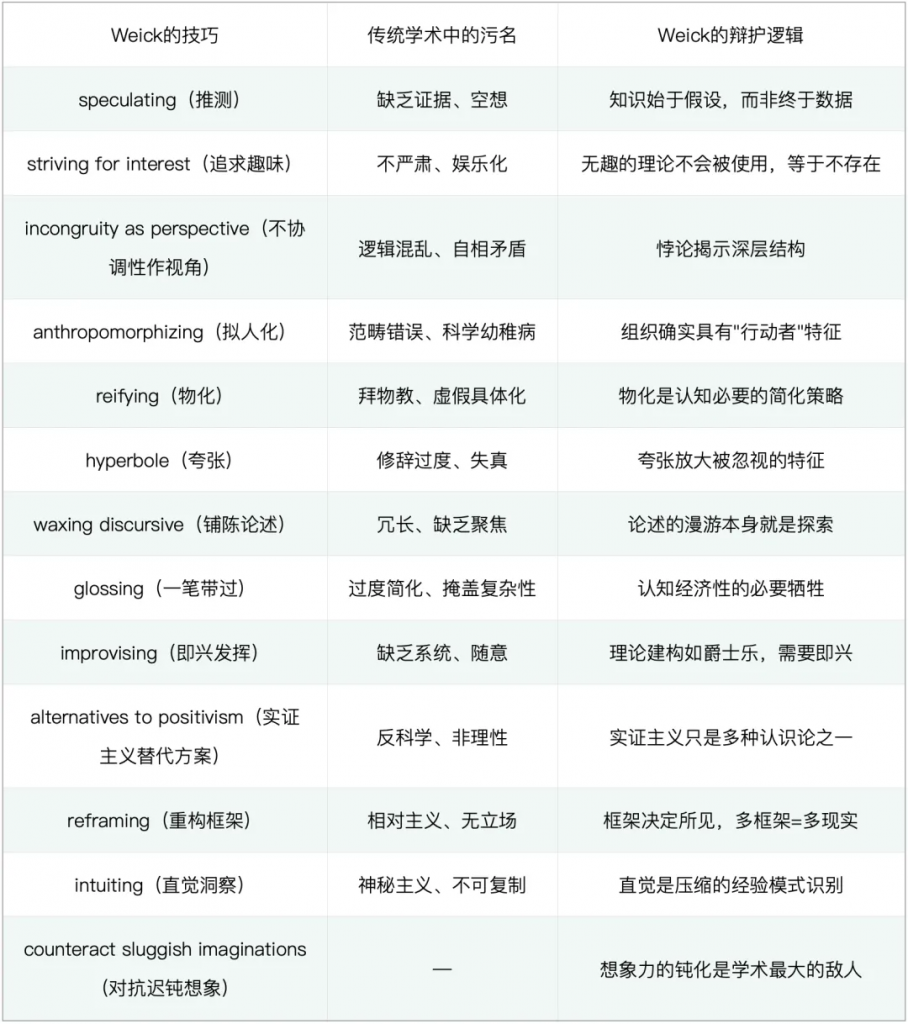
关键修辞:”we will not be timid”——这不是谦逊的学术声明,而是战斗檄文。Weick公然拥抱被污名化的方法,将其重新定义为认知勇气。
Weick的终极方法论立场是:组织理论家的任务不仅是传递正确的理论,而是培养持续建构理论的心智能力。因为在这个组织迅速变化的世界里,唯一不会过时的,是理论建构活动本身。
这段文字是Weick的”学术宣言”,其修辞策略值得细品:
- 联盟建构:通过引用Bakan、Moscovici、Davis、Koestler等”异端”,Weick将自己定位为学术理论的整合者
- 自我标签化:主动拥抱污名,将人们眼中的弱点视为为风格
- 挑衅正统:”examining alternatives to positivism”——在1970年代的美国组织理论界,这是不正确的
- 实用主义辩护:最终标准不是”真/假”,而是”是否对抗迟钝的想象力”——有用即真理的詹姆士式的实用主义
其中,Davis (1971) 特别重要:
这篇经典文章提出,理论的价值不在于”证明什么是对的”,而在于”什么是有趣的”——即挑战常识假设、反转预期。Weick将此作为核心方法论原则。
“长期以来,人们认为一位理论家之所以伟大,是因为他的理论为真,但这是错误的。一位理论家之所以伟大,不是因为他的理论为真,而是因为它们有趣。”
Davis (1971)的精髓在于——不要问”这个理论对吗?”,而要问”这个理论让我注意到了什么以前没注意到的?” 这一标准贯穿Weick的全部著作,也是理解组织理论作为”认知艺术”而非”科学程序”的关键。
原文:As a final exhibit of what it takes to think deeply and provocatively about organizations, consider madness (Lichtenstein 1971). Madness is to think of too many things in succession too fast or of one thing too exclusively (Auden and Kronenberger 1966, p. 351). Generating ideas about organizations sometimes borders on madness. People free-associate, introspect, rifle through piles of images, and play percentages that they’ll find something that captures a portion of organizational reality everyone else has missed. They think of too many things, often too fast. At other times the passionate investigator becomes obsessed with a single image and can see or talk about nothing else. All the world becomes filled with least preferred coworkers, cognitive dissonance, prisoners’ dilemmas, resource dependence, or garbage cans. That’s functional, if unnerving, because it aids the development and exemplification of the obsession and it keeps something tangible in front of other investigators, something. on which they can sharpen their contrasting arguments. In all of this, madness lies not far below the surface (Mol 1971; Chafetz 1970; Ziman 1970; Graves 1970; Merton 1969; Mitroff 1974; Weisskopf-Joelson 1971).
参考译文:作为对”深入且富有挑衅性地思考组织需要什么”的最后一个展示,让我们考虑疯狂。疯狂就是过快地连续思考太多事物,或者过于排他性地思考单一事物。产生关于组织的观念,有时濒临疯狂。人们自由联想、内省、翻检成堆的意象、赌概率——期望找到某种能够捕捉其他所有人都遗漏的组织现实片段的东西。他们思考太多事物,往往太快。另一些时候,充满激情的研究者沉迷于单一意象,除此之外什么也看不见、什么也谈不了。整个世界都充斥着最不喜欢的同事、认知失调、囚徒困境、资源依赖,或者垃圾罐。这虽然令人不安,却是功能性的——因为它有助于该执念的发展与例证化,并且将某种具体可感的东西置于其他研究者面前,让他们可以磨砺其对立论点。在所有这些活动中,疯狂就在表层之下不远处。
In the remainder of this chapter, six thinking tactics will be examined, each stated in the form of advice:
在本章剩余部分,将考察六种思考策略,每种都以建议的形式陈述:
1. Know what you’re doing.
知道你在做什么。
2. Acknowledge tradeoffs.
承认权衡取舍。
3. Think “ing.
“思考”ing”(过程)。
4. Mutate metaphors.
变异隐喻。
5. Incorporate interest.
纳入趣味性。
6. Evoke minitheories.
唤起微型理论。
💡学习笔记:
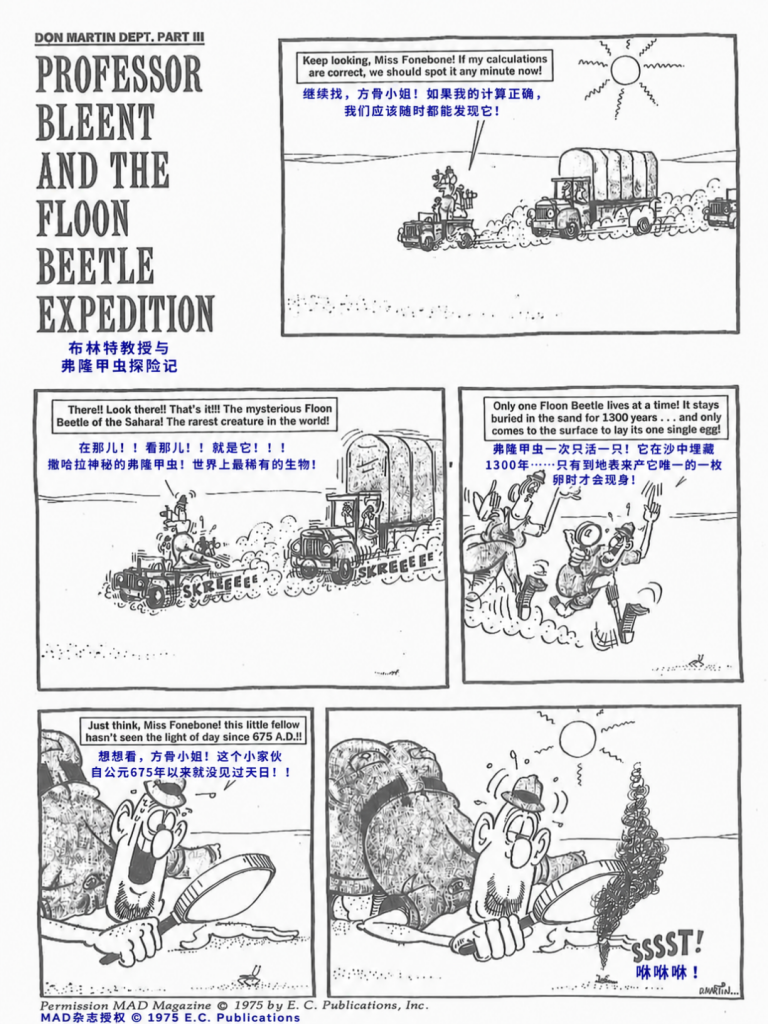
一、表层叙事:科学探险的荒诞
这是一出典型的 Don Martin 式闹剧:
- 宏大的科学叙事(1300年、唯一生物、公元675年)→ 渺小的现实对象(一只几乎看不见的甲虫)
- 精密的计算与预测 → 完全失控的结局(甲虫喷出巨量卵,而非”唯一的一枚”)
- 教授的崇高情感(热泪盈眶)→ 滑稽的物理后果(被卵喷一脸)
二、这幅漫画是 Weick 方法论的视觉浓缩:
组织研究者如同布林特教授——带着精密的计算、崇高的情感和唯一的理论框架,跪在经验的沙漠中。而组织(弗隆甲虫)永远会以”SSSST!”的方式,溢出我们的框架,嘲笑我们的痴迷,并在我们眼前改变自身。真正的”思考策略”不是避免这种荒谬,而是学会在荒谬中保持清醒——知道我们在做什么,承认权衡,思考过程,变异隐喻,纳入趣味,唤起微型理论。
Know What You’re Doing
知道你在做什么
原文:In 1941 John Steinbeck anticipated the foul-up in the Floon Beetle Expedition when he was on an expedition of his own in the Gulf of California (the Sea of Cortez) collecting biological specimens with Ed Ricketts (Hedgpeth 1971). Steinbeck became fascinated with a species of fish called the Mexican Sierra.
参考译文:1941年,约翰·斯坦贝克在加利福尼亚湾(科尔特斯海)与爱德·里克茨一同采集生物标本时,就已经预见到了”弗隆甲虫探险”中的那种搞砸。斯坦贝克对一种名为墨西哥西鲱的鱼类产生了浓厚兴趣。
原文:The Mexican Sierra is shaped like a trout, has brilliant blue spots, ranges from 15 inches to 2 feet, is slender, is a very rapid swimmer, is classified with mackerel-like forms although its meat is white and delicate and sweet, weighs up to 14 pounds, and occurs in the northern half of the Sea of Cortez (composite descriptions from Steinbeck 1941, p. 155, and Cannon 1973, p. 263, “Sierra Grande”).
参考译文:墨西哥西鲱形似鳟鱼,有亮蓝色斑点,体长从15英寸到2英尺不等,身形纤细,游速极快,虽被归类为鲭鱼类,但其肉质白皙、细腻、甜美,体重可达14磅,分布于科尔特斯海北部。
Here is what the Sierra has to do with thinking:
以下就是西鲱与思考之间的关联:
原文:The Mexican Sierra has 17 plus 15 plus 9 spines in the dorsal fin. These can easily be counted. But if the sierra strikes hard on the line so that our hands are burned, if the fish sounds and nearly escapes and finally comes in over the rail, his colors pulsing and his tail beating the air, a whole new relational externality has come into being-an entity which is more than the sum of the fish plus the fisherman. The only way to count the spines of the sierra unaffected by this second relational reality is to sit in a laboratory, open an evil-smelling jar, remove a stiff colorless fish from the formalin solution, count the spines, and write the truth. … There you have recorded a reality which cannot be assailed-probably the least important reality concerning either the fish or yourself.It is good to know what you are doing. The man with his pickled fish has set down one truth and recorded in his experience many lies. The fish is not that color, that texture, that dead, nor does he smell that way (Steinbeck 1941, pp. 2-3).
参考译文:墨西哥西鲱的背鳍有17根加15根加9根棘刺。这些很容易计数。但如果西鲱猛烈撞击钓线,以至于我们的手被灼伤;如果鱼下潜深处,几乎逃脱,最终却被拉过船舷——它身上的色彩脉动着,尾巴拍打着空气——那么一种全新的关系性外部性便应运而生:一个大于”鱼加渔夫”之和的实体。要不受这第二种关系性现实的影响而计数西鲱的棘刺,唯一的方法是坐在实验室里,打开一个散发恶臭的罐子,从福尔马林溶液中取出一具僵硬、无色的鱼尸,数完棘刺,然后写下”真理”。……在那里,你记录下了一种不可攻击的现实——但这也可能是关于那条鱼或关于你自身最不重要的现实。知道自己在做什么,这是好的。那个拿着腌制鱼的人写下了一种真理,却在他的经验中记录了许多谎言。那鱼不是那种颜色,不是那种质地,不是那么死的,它也不散发那种气味。
💡学习笔记:
Weick 通过斯坦贝克的西鲱寓言揭示:
“知道你在做什么”的终极标准,不是你获得了多少“不可攻击的真理”,而是你是否清醒地意识到——每一种求真方式都在同时制造“谎言”,每一次计数都在消除某种关系,每一个实验室都在远离某种海洋。真正的认知成熟,是在“腌制”与“鲜活”之间保持自觉的张力,而非盲目地选择一方。
Weick 想说的是:
做研究就像钓鱼。你可以把鱼带回家,泡在药水里,仔细数它有几根刺——这很精确,但这已经不是那条鱼了。真正重要的,是鱼在海里游动时,你与它之间的那种”较量”——那种紧张、尊重、生命的碰撞。好的研究者,不是那些最会数刺的人,而是那些知道”数刺”意味着什么、放弃了什么、并且对这种放弃保持清醒的人。”知道你在做什么” 的终极含义:不是掌握方法,而是掌握方法背后的代价。
(下一期,我们继续学习)
本文选自卡尔·E·韦克《组织化的社会心理学(第二版)》相关章节,原书书名为:The Social Psychology of Organizing (Second Edition),Karl E. Weick ,ADDISON-WESLEY PUBLISHING COMPANY,1979。为阅读及排版便利,参考译文中删去了部分注释,有需要的读者可参考原文。
声明:本笔记内容为个人研读管理学的学习笔记,包括:对原文的个人翻译、个人解读、逻辑梳理、思考评论及知识拓展等内容,仅用于学术交流及免费分享,无任何商业目的。